Please note: this article is general information to help you understand GST bills. Tax rules change and every business is different, so confirm what applies to your shop with your CA or tax consultant.
Do I need to give a GST bill at all?
That depends on whether your business is registered under GST.
- Registered shops have a GSTIN and must issue a proper GST document for every sale.
- Unregistered shops do not have a GSTIN, cannot charge GST, and give the customer a simple bill or receipt.
Registration becomes compulsory once your yearly turnover crosses a limit set by the government. For shops selling goods, that limit is ₹40 lakh in most states and lower in some. Ask your CA which limit applies to you.
Tax Invoice: the standard GST bill
A tax invoice is what a regular GST-registered shop gives when it sells taxable goods. It shows:
- Your shop name, address and GSTIN
- An invoice number and date
- Each item with its quantity, price and GST rate
- The tax amount, split into its parts
- The final total
CGST, SGST and IGST in one minute
GST is shared between the central and state governments. That is why the tax on a bill is split:
| When you sell to | Tax on the bill | Example at 18% GST |
|---|---|---|
| A customer in your own state | CGST + SGST, half each | 9% CGST + 9% SGST |
| A customer in another state | IGST, the full rate | 18% IGST |
The customer pays the same total either way. Only the split on the invoice changes.
Bill of Supply: when no tax is charged
A Bill of Supply looks like an invoice but has no tax on it. Registered businesses use it in two common cases:
- Composition scheme dealers. Small businesses that have chosen the composition scheme pay tax at a flat rate on turnover and are not allowed to charge GST to customers.
- Exempt goods. Some items carry no GST, so there is no tax to show.
How BillKaro handles all of this
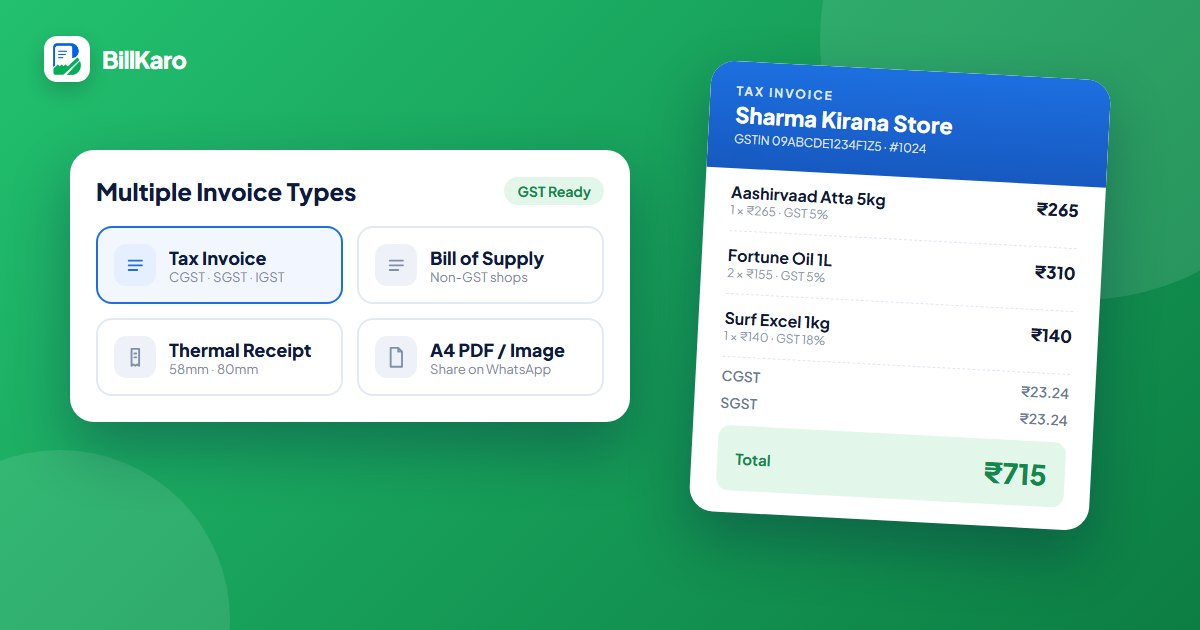
BillKaro – Digital Dukaan supports multiple invoice types, so you choose the document that matches your shop:
| Invoice type | Best for |
|---|---|
| Tax Invoice | GST-registered shops. CGST, SGST and IGST are calculated for you. |
| Bill of Supply | Shops that do not charge GST on the bill. |
| Thermal Receipt | Fast counter billing on a 58mm or 80mm Bluetooth printer. |
| A4 PDF / Image | Sending a full-page bill to the customer on WhatsApp. |
You enter the items once. The app applies each item's GST rate, splits the tax correctly, and puts your GSTIN on the invoice. There is no separate calculation to do and no formula to remember.
Five common GST billing mistakes
- Charging GST without being registered. Only shops with a GSTIN may collect GST.
- Wrong GST rate on an item. Atta, oil and detergent do not carry the same rate. Set the rate once per item and let the app reuse it.
- Using CGST + SGST for an out-of-state sale. Sales to another state need IGST.
- Missing or repeated invoice numbers. Invoices should run in sequence. An app numbers them automatically.
- No copy of old bills. Keep your records. With BillKaro they stay in the app and are protected by cloud backup.
The benefit beyond compliance
A correct GST bill is not only about following rules. Business customers prefer to buy from shops that give proper tax invoices, because they can claim the tax back. Clean invoices and reports also make life easier when you sit with your CA or apply for a business loan.
Not registered yet? You can still use BillKaro today with simple bills and receipts. If your shop grows and you register for GST later, switch to tax invoices in the same app.
Try BillKaro in your shop today
Bill, print, GST and udhaar in one app. Free to download, in Hindi and English.
Download free on Google Play →